
Agriculture and Natural Resources
Contributing Author(s):
Garrett Ulmer, Master’s Students, Department of Animal Science, University of Tennessee, Knoxville
Troy Rowan, Assistant Professor, Beef Cattle Genomics, Department of Animal Science, University of Tennessee, Knoxville
Saulo Zoca, Assistant Professor and Extension Beef Cattle Specialist, Reproductive Management, Department of Animal Science, University of Tennessee, Knoxville
Strategic crossbreeding can drastically improve herd performance and overall profitability of an operation when producers establish clear breeding objectives. Breeding objectives outline the goals of an operation and promote targeted improvements in areas that have the greatest impact on profitability. Isolating maternal and terminal breeding goals allows for targeted selection on the most relevant traits. Maternally focused programs producing replacement females should select for traits related to longevity and reproductive ability, while terminally oriented operations that market entire calf crops should focus on maximizing the growth and meat quality of their calf crop.
Crossbreeding aids producers in making progress on a variety of economically relevant traits involved in both maternal and terminal breeding objectives through heterosis and breed complementarity. Heterosis is the increased performance of crossbred progeny when compared to their straightbred parents. Research suggests that crossbred cows wean nearly one additional calf over their productive lifetime than straightbred cows. Breed complementarity allows progeny to capitalize on the strengths of multiple breeds to be better suited to make progress towards production goals. An example of breed complementarity is the cross between Angus-Charolais that combines the maternal ability and carcass quality of the Angus breed to the cutability and growth of the Charolais breed, producing a high-quality and high-yield terminal calf. Although the benefits of crossbreeding are evident in maternal production, terminal output, and increased economic gain, implementation of a crossbreeding program may increase management intensity for small and medium size cow herds with fewer bulls or readily available breeding pastures.
Crossbreeding for maternal production can be very profitable for cow-calf producers, as heterosis is most prevalent in lowly heritable traits such as maternal ability, longevity, fertility, and health. Breed complementarity enables crossbred females to be better adapted to their production environment than their purebred counterparts. Numerous breeding schemes to maximize heterosis are available for various herd sizes and resource availabilities. Rotational crossbreeding systems are a common way to introduce heterosis in smaller cow herds that produce their own replacement females. In rotational systems, resulting progeny are bred to the parent breed that makes up the smallest portion of their own composition (Figure 1A). This means that in an Angus-Hereford rotation, females sired by Hereford bulls are bred to an Angus sire. In three-breed rotations, a third breed of sire is introduced, and cows are mated to the breed they are least related to. Though heterosis cannot be fully maximized in rotational systems, as progeny will share some breed composition with the breed they are mated to, heterosis is introduced and maternal production is expected to increase.
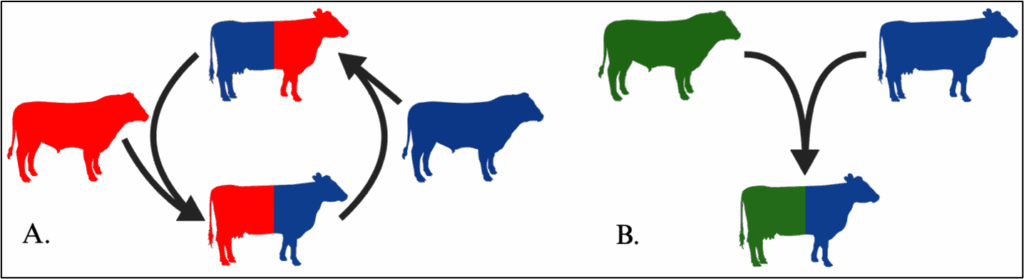
Figure 1. Crossbreeding strategies. A) Two-breed rotational crossbreeding scheme in which females are mated to the sire breed they are least related to. B) Terminal crossbreeding scheme in which maternal females are bred to a terminal sire breed and all offspring are marketed as feeders.
Terminal crossbreeding allows for selection pressure to be redirected to growth and carcass quality to heighten profit from consumer marketable traits (Figure 1B). Producers breeding for terminal production should emphasize traits affecting the sale point of the calf crop. For example, exceptional carcass traits are less important for calves sold at weaning than those retained through harvest. A major advantage of terminal crossing is the ability to maximize terminal output without the negative effects of increased mature cow size and decreased maternal ability in replacement females. The key to a successful terminal breeding system is the discipline to market all terminally bred females, regardless of the phenotypic qualities they may possess. Retaining terminal-cross heifers undermines terminal systems by increasing mature cow size and maintenance requirements without improvement in maternal performance. In larger herds, a fraction of the herd may be dedicated to producing replacement females while the remaining cow herd is devoted to terminal production. Purchasing quality replacement females may be a more economically feasible option for operations with less labor and land resources. A classic example of a terminal breeding system is seen in operations that breed the entire cow herd to a sire selected for growth and carcass quality and retains ownership of the resulting calf crop as feeder calves. Replacement females are purchased from a separate operation devoted to breeding and developing quality crossbred females that are well adapted to a similar environment.
Continuous advances in reproductive technology allow small and medium sized producers to capitalize on the benefits of crossbreeding without the hassle of managing multiple breeding groups. Artificial insemination (AI) offers significant opportunity for producers to improve the genetic quality of their cattle while also reducing the number of bulls needed for breeding, making crossbreeding an option for one bull herds. Some producers may choose to adopt a fixed-time artificial insemination (FTAI) protocol with a clean-up bull and retain only females from AI matings, capturing superior genetics in replacement females. Sexed semen technology in combination with a FTAI protocol provides an innovative solution for progressive operations seeking to simultaneously create high quality maternal and terminal individuals without the drag of maternally bred male calves. In a proposed protocol for meeting both maternal and terminal breeding objectives, females displaying estrus following a FTAI protocol are bred with female sexed semen and a sire selected for terminal quality is used as a clean-up to breed females that did not displayed estrus. This protocol would result in AI-sired replacement female candidates born at the beginning of the calving season while also producing a group of terminally sired calves that can be marketed on weight and carcass quality. Higher cost and lower conception rates may be an initial hindrance of utilizing sexed semen; however, this protocol may prove to increase cow efficiency and producer revenue as reproductive technologies are continuously being optimized. Embryo transfer is another advanced reproductive technology which allows producers to rapidly multiply the number of progenies from elite dams. This technology is likely more cost effective for operations with avenues to market superior genetics.
Whether the goal of your operation is to produce quality replacement females or maximize terminal output, strategic crossbreeding is a proven tool to make progress in every economically relevant trait. Crossbreeding should be approached with an established breeding objective and knowledge of the resources available on your operation. Effective crossbreeding is a long-term process that allows your operation to heighten production and increase profitability. Reproductive technologies, such as estrous synchronization protocols, can be used to optimize crossbreeding strategy, for option of estrous synchronization visit beefrepro.org.