
Agriculture and Natural Resources
Spring fever, grass fever, and stocker fever are the trifecta of fevers that can either bring prosperity or put a person down for the count. Spring fever is an ailment commonly occurring in people who work indoors, but it can infect those with professions that work outdoors, behind a steering wheel, or even those who do not work, though it is less prevalent in the latter. Spring fever in cattle producers largely is associated with fertilizing and spraying pastures and hay fields and rounding up rogue cattle that have found a hole in the fence. Grass fever is a condition impacting livestock producers who like to purchase animals to graze spring and summer grass and hope to make a positive return because the cost of grazing is low relative to other feeding methods and programs. From the cattle producers’ standpoint, this is largely associated with purchasing lightweight calves and growing them until pastures are depleted. This leads into what can now be called stocker cattle fever.
Stocker cattle fever is a new phenomenon. (It is not really new, but such a statement adds flavor to the story.) It is a serious condition of cattle buyers that may be good or bad. The symptoms that present themselves include purchasing or attempting to purchase calves of any size, color, or condition, paying too much when successfully purchasing cattle, and then hoping and praying feeder cattle prices stay high or move higher to achieve a profit. Stocker cattle fever is a serious condition, and it presents itself in a similar fashion as a gambling addiction. It simply does not matter how high the stakes or the risk being assumed, a person with stocker fever will always go back to the well for more water.
Some of this over dramatization is not necessary, but most of the symptoms are real. The easiest way to explain and illustrate what is happening is to look at lightweight cattle prices the past few years. Figure 1 contains the weekly auction average price in Tennessee for 500-600 pound steers. Starting with 2024, the price movement throughout the year is typical of what the market tends to do from a seasonal perspective. The one abnormality is how long lightweight calf prices remained elevated, because lightweight calf prices tend to peak in March or April before declining into the summer. The price of this animal tends to bottom out in the fall, which is exactly what happened in 2024.
Moving to 2025, the price of 500-600 pound steers started high ($300/cwt) and continued to increase throughout the entire year. It would appear there was a plateauing of prices in the last quarter of the year, but prices increased nearly $100 per hundredweight over that year which is a $550 per head increase in value. The 2025 price movement appears to have extended into 2026 as prices started near $400 per hundredweight and had increased $62 per hundredweight by the end of February. The first week of 2024, a 550 pound steer in Tennessee averaged $1,350 per head. The same animal the first week of 2025 was valued at $1,640 per head and then $2,240 per head the first week of 2026. By the end of February 2026, the same animals were valued at $2,540 per head.
This almost seems like a lot of babbling about numbers, but the story in this is that stocker producers continue to chase these cattle regardless of what they are having to pay for them. The January Cattle Inventory report made it clear there are fewer animals to be traded, which is certainly why cattle prices have increased. The increase in price should ration consumption of a good, but cattle are an input to these operations. Operators know there is no way to make money with cattle if they do not have any cattle. It is just like a person playing the lottery. A person cannot win the lottery if they do not own them.
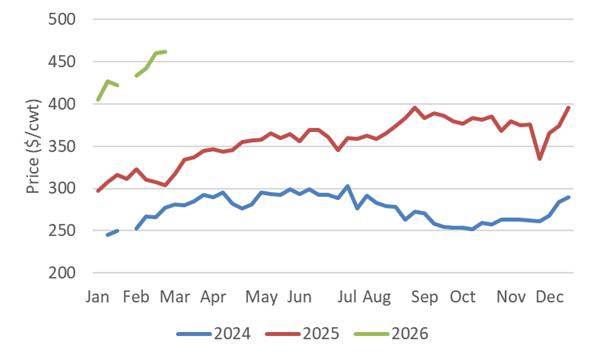
Figure 1. Tennessee Weekly Auction Average Price for 500-600 pound Steers.